Introduction
Finding a strange software code can be frustrating, especially because the name can sometimes look like a bunch of random letters and numbers. DH58GOH9.7 is an example. It can look like a software version, development build, firmware label, internal module, or technical identifier, but we don’t know what it is for sure.
People looking up the dh58goh9.7 code may have found it in the software installation, a system information page, a technical document, a log file, a device interface, or even a website. Other people may be looking up the dh58goh9.7 software name to see if it is a real software application and what it does.
There is not much official developer documentation that says DH58GOH9.7 is a commercial software product. Most of the public pages in the last several years have said it is an internal, imaginary, experimental, or version-style identifier. Some other pages have said what it can do, but they have not cited any verifiable primary sources.
Because of that, identifying it is very important.
If it is not clear what the code is, the most useful thing might be identifying the context in which the code was found. The same kind of code can be used in software releases, firmware builds, a backend component, a testing version, or even an internal enterprise system.
This guide will help you understand what the DH58GOH9.7 code represents if you find it, how to identify what software the code represents, how to analyze the risks of using the software, and how to improve the software if it really does have a software project on the back end.
What is the Meaning of DH58GOH9.7 Code?
The short answer is that DH58GOH9.7 is likely some sort of technical code and version, but is impossible to know its meaning from the code alone.
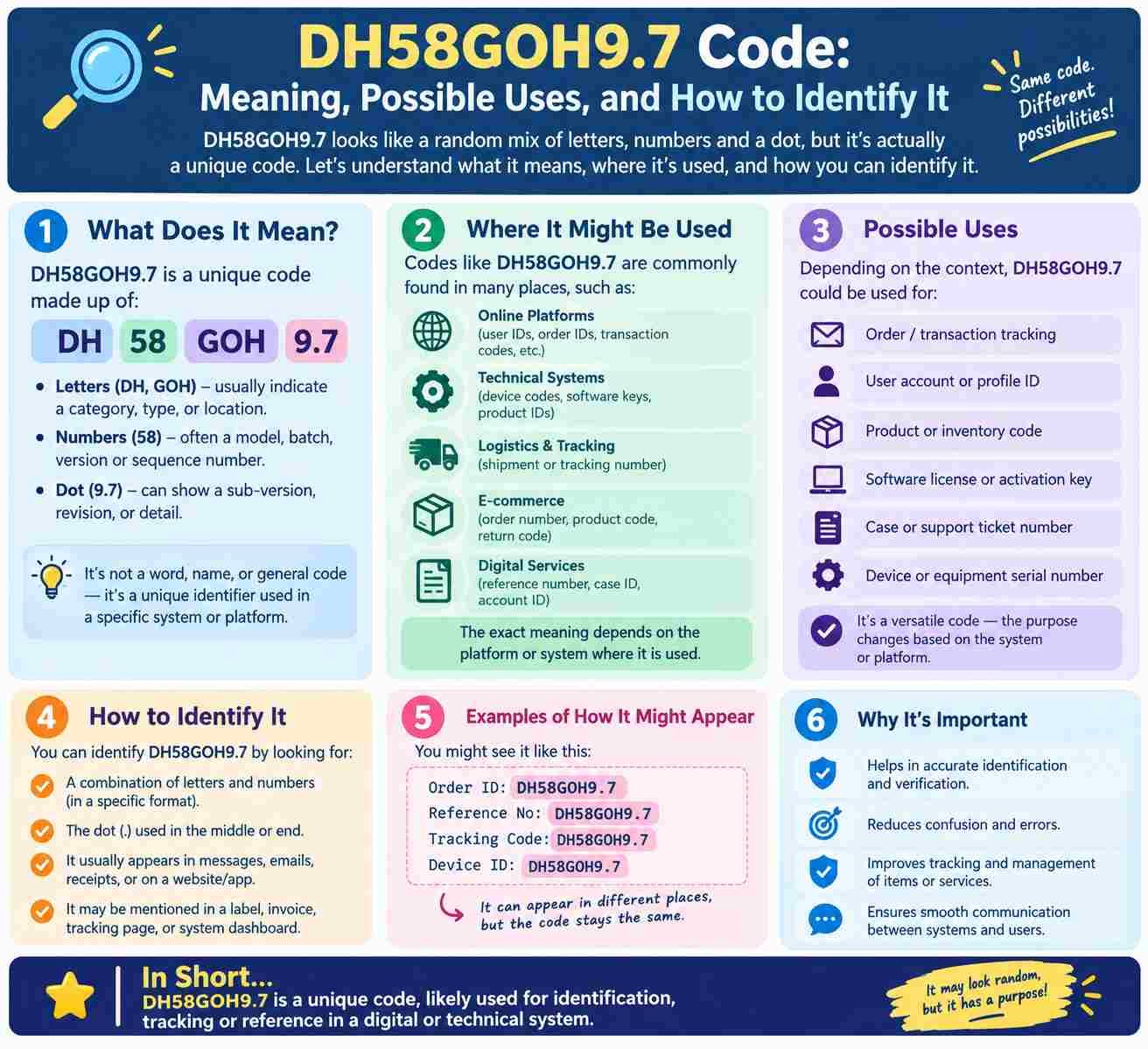
The code is made up of:
- Letters
- Numbers
- A period
- A version-like code number
The code structure is usually seen in a more technical setting.
It is very normal for software developers to create codes to differentiate between:
- Builds
- Releases
- Modules
- Components
- Versions of Firmware
- Testing
- Internal Projects
Still, there is no way of knowing what DH, 58, GOH, or 9.7 represents.
For example, it would be wrong to assume that 9.7 is a version 9.7, and nothing else could represent.
The code could mean a version, but it could also mean a revision, build, or branch, or a piece of a code.
DH58GOH9.7 Code, Does it Look Like Software?
The code structure looks very much like a naming convention of a more technical software code.
Normally, in consumer software, there is an end product that is consumer facing, and there is the software code that is more technical and kept for the internal use of the software company.
A software code can look like this:
Public Name: Example Manager
Internally Built Code: DH58GOH9.7
The internal code is much better for the software developers and engineers than the public code, because it is much easier to differentiate one build from all the other builds.
This is very important for the software company that has multiple builds of their software at the same time.
Is DH58GOH9.7 Code the Official Software Name?
There are not enough trusted reliable public data sources that can confirm that DH58GOH9.7 is the official name of a particular software from the consumers’ point of view.
Currently, several sites cover the identifier, but they do not explain it in the same way.
For example, one site says that DH58GOH9.7 is a kind of a hypothetical or an internal versioned identifier, and another site says that it represents a concept of software in a controlled technical environment, and in that regard, it is much broader.
Because of differing accounts, it is prudent not to take any of these as official product definitions.
This doesn’t mean that the code has no value.
It simply means that we need context.
Why Are Technical Identifiers Difficult to Understand?
Not really.
The problem is that the identifiers are designed for the use of internal systems and development teams, and not the general public.
They can be generated from any of the following:
- Project code
- Release number
- Build system
- Component name
- Internal naming convention
- Hardware setups
- Test
Since the code can be generated from a component name, a developer can immediately understand what a code means.
A regular user looking at the code for the first time may be unable to understand what it means.
This is a common occurrence.
What Can DH58GOH9.7 Mean?
In the absence of official documentation, several possibilities exist.
Software Build
It may indicate a specific software build.
Firmware Version
It may refer a version of hardware-embedded software.
Internal Application
It may refer a non-public business application.
Development Module
It may refer a module of a larger software application.
Testing Version
It may refer a test or quality control build.
Backend Component
It may refer the software behind a public application.
Package Identifier
It might be a part of a package or a part of an installation file.
This is why the code should be investigated, and it is likely to be in context.
Where can the DH58GOH9.7 code be?
Where the code appears is one of the biggest clues to what it could be.
1. Software About Page
A lot of computer programs have a section where they display some of the technical details about the program, and it’s located in the About section.
Here you might see:
- Program Name
- Program Version
- Build Number
- Publisher
- Copyright
- License
If DH58GOH9.7 appears in this section, it is likely to be a build or version identifier.
2. Device Settings
If the code appears in the device settings, then it is likely related to the:
- Firmware
- OS
- Build Number
- System Software
- Hardware-Specific Software
This is likely to be the case if the identifier is found in a section such as Software Information or System Information.
3. System Logs
Technical logs contain a lot of identifiers and code snippets that are likely to be unfamiliar.
A log might contain:
- Names of Processes
- Build Numbers
- Names of Modules
- Error IDs
- Software Versions
- Request IDs
If DH58GOH9.7 appears solely in a log, it does not mean that this is an application you need to install or uninstall.
This may be a reference that is used by the system.
4. Installation Files
The identifier might be the name of an installer or a software package, like
DH58GOH9.7_setup
or
DH58GOH9.7_package
If this is the case, then it’s very important where you got the file from and the who the file is from.
5. Developer Tools
As a developer, you will often see a technical identifier in conjunction with the following:
- Build systems
- Source repositories
- APIs
- Automated Testing
- Continuous integration
- Debugging
What may look like a strange code to a normal user, is completely expected in a development environment.
How to Identify DH58GOH9.7
If you want to know exactly what the code DH58GOH9.7 stands for, don’t start determining what you think each character stands for.
Instead, do the following.
Step 1: Note Where You Found it
Document the precise location.
Was it on a:
- Computer?
- Smartphone?
- Router?
Was it in a:
- Software application?
- Downloaded file?
- Error message?
- Website?
- Log?
This information may be more useful than the identifier.
Step 2: Find the Supporting Software
If the identifier is in an application, document the name of the application.
Example:
Application: Example Tool
Application Version: DH58GOH9.7
In the example, the name of the application is the most important piece of information, and the identifier states the version.
Step 3: Find the Publisher
Document the name of the publishing company or the software developer.
A legitimate application may contain:
- Publisher name
- Developer name
- Website
- Support page
- Copyright
If there is no identifiable publisher, do research and consider not installing or modifying the application.
Step 4: Look at the File Properties
If the identifier relates to a file, look at the file properties.
Depending on the OS, you may see:
- Product name
- File description
- Publisher
- File version
- Copyright
- Digital Signature
This information may confirm that the file is a part of a known application.
Step 5: Look at the Digital Signature
If the file is digitally signed, evaluate the signing info.
Digital signatures can indicate:
- Who signed the file
- If the file was altered after signing
While not completely secure, this is an important check.
Step 6: Look For the Original Download Location
Find out where the software originated.
For example:
From the official developer website: much more likely to verify software.
Well-known software store: likely to be able to verify the software.
From an unknown download site: software very likely to be suspicious.
Received as an unexpected email attachment: software very likely to be malicious, should be investigated thoroughly.
The download source provides much more info than the file name.
How to Determine if DH58GOH9.7 is Safe
If the identifier is unfamiliar, then it must be investigated.
Check:
- Who Published the Software
- Do you know where the software originated?
- Is the Software Digitally Signed?
- If No, What Access Does It Request?
- What does the Software Do When Run?
- Does it Show Any Signs of Malicious Intent When Run?
- Is There an Official Manual or Support Page?
DH58GOH9.7 and Malware Do They Mean the Same?
There is no way to definitely state that the code is malware.
Technical identifiers can seem arbitrary for completely legitimate reasons.
However, malware can use completely arbitrary filenames as well.
Therefore, the identifier by itself should not serve as the only security test.
A file named DH58GOH9.7 could be:
- A legitimate build
- An internal tool
- A firmware package
- A component
- An unwanted program
- A harmful file
The additional evidence is the only thing that can determine the difference.
Why is Context More Important than the Name?
Think about the following two examples.
Example One
You find DH58GOH9.7 in the system info of a device you bought from a legitimate manufacturer.
In that case, you can document support software from the manufacturer.
Example Two
You received a file DH58GOH9.7 from an unknown email.
This case requires much more caution.
While the code has not changed, the context is different.
This example demonstrates the importance of identifying the source.
What Could DH58GOH9.7 be Used For?
Although we cannot determine exactly what this identifier could be used for, it could align with a number of different software systems.
Enterprise Software
Custom software that an organization uses internally may not be public.
Development Systems
Builds or testing versions may require unique identifiers.
Embedded Software
A hardware device may contain a firmware build.
Automation Systems
Background tasks may have different versioning.
Backend Systems
Internal components of a service may be referenced by the same identifier.
Legacy Software
Older software may contain legacy business systems with the original developer’s naming system.
DH58GOH9.7 and Internal Software
A plausible explanation for a code that is not commonly used could be that it is from an internal software system.
Generally, internal software may not be marketed.
A program can serve many purposes like:
- Managing inventory
- Generating reports
- Managing workflows
- Processing data
- Managing employees
- Monitoring infrastructure
Internal users may come across revision codes that never make it to the public-facing side of the company’s websites. This is a possible cause for limited information when looking up the code.
DH58GOH9.7 as a Development Build
Having many versions is a normal part of the software development process.
A single tool can have:
- Development build
- Testing build
- Staging build
- Release candidate
- Production build
Each can have a different identifier.
When a problem is reported, each of those unique identifiers can help the team understand the exact circumstances under which the problem occurred.
A better bug report may be:
Internal Tool
Development Build: DH58GOH9.7
Export fails when conducting an export with a large dataset.
This is far more helpful than stating the tool is broken.
Why Build Identification Matters
Build identification helps:
- Identifying the cause of an issue
- Knowing which build contains an issue
- Returning to a stable build
- Knowing which build is the most stable
- Knowing which build contains the security fixes
- Knowing which build can be certified
- Knowing which build can support testing
- Knowing which build and its environment can support testing
Having a clear build identification can aid troubleshooting, testing, and securing the build.
What Features Should You Look For?
Since we are not aware of the actual software that is behind DH58GOH9.7, we cannot claim to have a complete and fixed feature set. If, however, you are using a tool that runs under this build identifier, you should check for:
- Options to configure the software
- Automate actions
- Process data
- Generate reports
- Manage users
- Logs
- API
- Integrations
- Monitoring
- Managing updates
The actual features should be confirmed through the application’s documentation or interface.
How to Find True Features
Look at the information the app provides
Look at the Main interface
Check the menus and tools
Look at the about section
It may tell you what product and what version it is
Look at the documentation
Check for a manual or a help center
Look at the release notes
These notes could tell you what features are added or changed
Look at the Developer
If you know the publisher, official documentation will be the best source.
Why Are Online Articles Misleading
When there are few pieces of official information and a lot of technical jargon, there are many gaps to be filled. As a result, there are many places that make assumptions.
One site may say that it is a conceptual enterprise platform.
Another site may go as far as to say it is a fully functioning software application.
Another site may go as far as to say that it is firmware.
New search results show this type of inconsistency for DH58GOH9.7.
Users should not take information as fact, just because it is on listed on multiple sites.
How to Analyze a DH58GOH9.7 Article
When reading a code article, ask:
Who is the Developer?
If there is no developer listed, then it is a guess
What is the Primary Documentation?
If it is linked, then it is better than a random blog post
Is the Evidence Technical?
Screenshots, manuals, release notes, or repositories are helpful evidence.
What is this based on?
Good articles should explain their reasoning
What Are the Claims?
If there are conflicting claims, the article may not be trustworthy
What Does it Mean to “Improve DH58GOH9.7 Software”?
When people search to improve DH58GOH9.7 software, they are generally looking to enhance or create new software related to this identifier.
Adding new features is one of many ways a software program can be improved.
Other approaches may involve:
- Making the software run faster
- Making the software run more reliably
- Making the software run more securely
- Making the software easier to navigate
- Making the software easier to use
- The software can be tested more thoroughly
- The software can be updated more reliably
- The software can be supported more readily
The appropriate priorities depend on the functionality of the software.
Ways to Improve DH58GOH9.7 Software
Improving a software program starts with reviewing the software program.
For a genuine use application of this identifier, consider the following.
Viewing the Current State of the Software Program
To begin, measure the current state of the software.
Some of the following can be measured.
- Time to start the software
- Time to respond to inputs
- How much of the CPU is used
- How much memory is used
- The network used
- How often does the software crash and report an error
Improve Code Efficiency
Resource consumption is significantly impacted by inefficient coding.
Some of the following can be used to improve coding efficiency.
- How algorithms are structured
- How database queries are constructed
- How loops are constructed
- How network requests are made
- How file operations are made
- How background processes are handled
Instead of improving all the code, focus on the code that addresses the most significant performance issues.
Improve Memory Management
Poor memory management leads to memory leaks and resource wastage.
Some of the following can be used to manage memory more effectively.
- Processes that never release objects
- Caching that is not necessary
- Files that are large and loaded into memory
- Background processes that never end
- Cleanup of resources that is unmanaged
More effective memory management leads to fewer crashes and better performance of the software.
Improve Stability
Reliability may be improved by addressing performance issues of the software, instead of adding new features.
Some of the following may improve reliability.
- Improved handling of exceptions
- Validating inputs
- Automated tests
- Crash reports
- Updated dependencies
Improve User Experience
If DH58GOH9.7 is a user-facing software program, software more understandable is easier to use.
Possible improvements include:
- Easier and cleaner navigation
- Simplified menus
- Better searching
- Clear status indicators
- Instructions
- Better error messages
- Responsive design
- Accessibility
The more powerful something is, the more it must be able to do. And you must be able to know how to use all of its power.
Make error messages more helpful
Something technical should be able to explain to the person what went wrong.
Instead of saying:
“Error 102”
It could say:
“Error 102″ means that the file that was asked to be opened does not exist. Or the application does not have permission to access the file.”
Helpful error messages allow the person to debug their issue and not have to reach out for help.
Make security better
Security is something that needs to be ever changing.
Possible improvements include:
- Better authentication
- Role security
- Better encrypted files
- Better validation and security of input data
- Safer file storage
- Dependency scanning
- Vulnerability testing
- Audit logging
If the application allows for the use of personal and sensitive data, the security of the application especially needs to be a priority.
Improve Integration
Applications should be able to communicate with other applications.
This could mean many different things based on the specific application.
- APIs
- Databases
- Cloud
- Authentication
- Reporting
- Business applications
All integrations should be documented and secured with the appropriate security measures.
Improve Compatibility
Applications should work in many different environments.
A strong compatibility strategy should include all:
- Supported operating systems
- Required hardware
- Supported browser versions
- Runtime dependencies
- Required versions of databases
- Required network dependencies
Testing common combinations of the above may help ensure that no compatibility issues are introduced.
Improve Documentation
Documentation is especially important when software has an unusual technical name.
What does the Documentation include?
Documentation will explain what the software does, what the identifiers are, how to install and configure the software, what features and requirements the software has, how to troubleshoot the software, how secure the software is, and how to maintain and update the software.
Software Documentation and Its Identifier
Documentation Software DH58GOH9.7 will be improved to include user centric and measurable software documentation issues. User centric improvements may be broken down into the following steps:
- Step 1 – Audit: understand complete software documentation
- Step 2 – Measure: analyze user documentation metrics
- Step 3 – Prioritize: define problem metrics
- Step 4 – Develop: software documentation improvements
- Step 5 – Validate: validate software documentation
- Step 6 – Deploy: Release documentation
- Step 7 – Measure: Analyze documentation metrics
- Step 8 – Sustain: Document improvements to software
Future Improvements to the DH58GOH9.7 Software Build Identifier
The goal of future software builds will be to allow users to discern the nature of the changes to the software builds. For example, users should be able to tell the differences between a production and a test build, as well as what and when improvements, bug fixes, and security updates were implemented.
Future Improvements to DH58GOH9.7 Software Build: Automated Testing
To better ensure improvements are consistently delivered while also reducing the risk of introducing new issues, automated testing will be implemented. Automated testing will include the following: unit testing, integration testing, regression testing, security testing, and performance and compatibility testing.
Future Improvements to DH58GOH9.7 Software Build: Better Monitoring
To enhance the user experience, monitoring the software will help to proactively identify issues. Better monitoring in the future will include real time metrics such as user session monitoring and error tracking while also considering user privacy.
Future Improvement: Better Update Delivery
A good update system can simplify future maintenance.
A good system implements:
- Safe downloads
- Confirmed versions
- Change notes
- Backup instructions
- Rollback instructions
- Update progress
Users deserve to know the benefits of an update before they elect to install one.
Future Improvement: Smarter Automation
For repetitive functions of the core software, increased productivity through automation becomes a possibility.
Potential areas include:
- Scheduled processing
- Automatic reports
- Data validation
- Backups
- Monitoring
- Deployment
- Alerts
Automation should always be evaluated before it’s employed for mission critical production activities.
Future Improvement: AI Features
Tasks of a software system that include the following may benefit from the inclusion of AI:
- Classification
- Search
- Prediction
- Analysis
- Interpreting logs
- Natural- language engagement
The addition of AI becomes warranted in any of the areas mentioned above; however, this technology should not be added merely to fall in line with the latest tech trends.
Prior to adding AI, barriers to entry include considerable expenses for
- Accuracy
- Privacy and security concerns
- Lack human oversight
How Users Can Help Improve the Software
Software users can provide much needed information to help developers.
Useful bug reports include:
- Software version
- Device type
- Operating system
- Exact error report
- Steps to recreate error
- Expected results
- Actual results
- Screenshots (if needed)
More easily helps reproduce and remedy the error.
What Not to Do With Unknown DH58GOH9. Software
Do not make drastic changes before you discover the software’s true intent.
To avoid problems, do not:
- Delete unknown system files
- Change registry entries you don’t understand
- Flash unknown firmware
- Use random versions
- Use cracked packages
- Disable security tools
- Run unknown files with admin rights
- Use unverified commands
- Install software without a backup
What if you see DH58GOH9.7 out of nowhere?
Think about what has changed lately:
- Installed new software?
- Updated system?
- Added new hardware?
- Downloaded new files?
- Other users changed the system?
- New software?..
What if you see DH58GOH9.7 after an Update?
If you see a new technical ID after an update, it doesn’t always mean something is wrong. It could be:
- New build
- New hardware
- New firmware
- New dependency
Believe or check the update notes. If you see new “behaviors” from your system, you can check it.
What if you see DH58GOH9.7 and it is making system errors?
Document ALL of the errors:
- Full error message
- Error number
- Software name
- Software version
- OS version
- OS version info
- Recent updates
- Detailed reproduction steps
After you document ALL of the above, you can tell if it really is an issue with DH58GOH9.7 and not software you are running.
Can you remove DH58GOH9.7?
It depends. If you are seeing it because it is a common software, you can probably delete it like normal software.
If what you’re looking at is a component of a system or firmware, taking it out could create issues.
You should not just uninstall or delete something strange looking because its name does not make sense.
Do a proper identification first!
Is There a Valid Download Source for DH58GOH9.7?
As of now, there is no known public download source of DH58GOH9.7 on record.
Users should therefore beware of websites claiming to offer this product.
A name does not make a product legitimate.
Better to do some research than to blindly trust an unverified download source.
Why You Should Stay Away from Unofficial Software
Unofficial software is very likely to be a modified version of the original software.
This could potentially be anything from:
- Malware
- Adware
- Spyware
- Unwanted programs
- Backdoors
- Disrupted functionality
To even altered the original software that was legitimate.
You should go for the trusted distribution channel of the software when available.
DH58GOH9.7 Identification Checklist
Use the following checklist when trying to identify the code:
- Where is it located?
- What is the name of the Device it is located in?
- What is the name of the Application it is associated with?
- Is there a name of the Publisher or Manifest?
- Is there a Developer website?
- Is the file signed?
- Where is the file from?
- Is there any Reference to it in the Official Documentation?
- What version is it?
- Does it trigger any Security Software?
- What are the events that occur prior to its detection?
Frequently Asked Questions
What is the DH58GOH9.7 code?
The DH58GOH9.7 code looks to be a system or a variant style name and is a somewhat rare alphanumeric identifier. There is no known record from an authoritative developer documenting its purpose.
Is DH58GOH9.7 a software application?
It is possible that it is related to software, but there is not enough substantiated public information available for it to be justified as a particular corporate application.
What does DH58GOH9.7 mean?
The designation DH58GOH9.7 has no public meaning attributed to it. While the final segment 9.7 does look like a version number, it is not documented and should not be assumed to be a legitimate version.
What is the software name DH58GOH9.7?
This term is a way to reference a rare technical software name that has been posted online. No available sources disclose a conclusive official product name.
Is DH58GOH9.7 safe?
The code alone does not indicate the safety of the software. You need to assess the publisher, source, digital signature, permissions, behavior, and results of a security scan.
Is DH58GOH9.7 malware?
There is no evidence that the code refers to malware. An atypically technical name alone is insufficient to make a determination of a file’s malicious integrity.
Where might I find DH58GOH9.7?
It might be found in version infomation of software, device settings, firmware, system logs, installation files, a development environment, or an internal system of a company.
How do I identify DH58GOH9.7?
You need to start by determining where you found the code. Then identify the application or file that code references, check the publisher and the digital signature also check where you found it.
Can DH58GOH9.7 be a version of firmware?
There is a chance that a code in a format similar to this can be used as a format for firmware, however, we do not have sufficient authoritative information to indicate that this code is firmware.
Can DH58GOH9.7 be a version of an internal software build?
The answer is affirmative. Internal builds, as well as builds for testing and development, can be assigned development identifiers. Nevertheless, this is a possible case and not a defined one.
How can I enhance DH58GOH9.7 software?
If you own the authentic software to which this identifier refers, you may consider enhancing the performance, stability, security, and usability, as well as the compatibility and documentation of the software. You may also improve the quality of testing and the provision of updates.
How will you make DH58GOH9.7 software better for the future?
Conduct an audit, set benchmarks for performance and reliability, identify the most critical issues, and address them in a prioritized fashion. Make all modifications in a controlled manner and observe the outcomes post-implementation.
Is it safe to install unknown DH58GOH9.7 software?
No. Investigate the source, publisher, file signature, intent, and safety of the software.
Should you remove DH58GOH9.7 from your computer?
Not necessarily. It may be a legitimate component of your system or one of your applications. Find out what it belongs to before removing it.
Why do different websites have different interpretations of DH58GOH9.7?
Due to limited authoritative documentation regarding this identifier, different websites are allowed to provide their own interpretations. Some cite it as a more internal or hypothetical identifier and others make more general claims regarding software.
Is there a DH58GOH9.7 official website?
There is currently no clearly established or verifiably official website that can be identified as the authoritative location for a commercial software product for DH58GOH9.7.
Conclusion
Right now, the DH58GOH9.7 code is an example of a unique technical code, which name alone cannot help figure out what the code is.
It is likely a type of technical build for a piece of software, a firmware, a component of a system, or even an internal application. There are, however, no reliable, publicly available documentation for an identification of a specific software for this code.
If you happen to find this code, the context would be the most important aspect.
This would include, the application or device that this code would be a part of, the publisher, the source of the file, and if there is official documentation about it. These and other factors would be helpful in identifying the code as a simple software version or an unknown and potentially unwanted file.
Evidence would be the foundation of judging the safety of this code. The name of DH58GOH9.7 would not imply that this code is malware, but this code should also be trusted like a software version.
For developers working with a real DH58GOH9.7 software project, there are a ton of things that could be done to improve it. Some of the things that could be done are to make the software more secure, more reliable, easier to use, and easier to integrate with other systems.
Improvements and updates to this software should be clear and well thought out. Instead of doing random things to the software, developers should try to identify the real problems with the software, and improve the areas of the software that would fix the most of these problems based on the users feedback and monitor the usage of the software to verify that these improvements addressed the problems.