
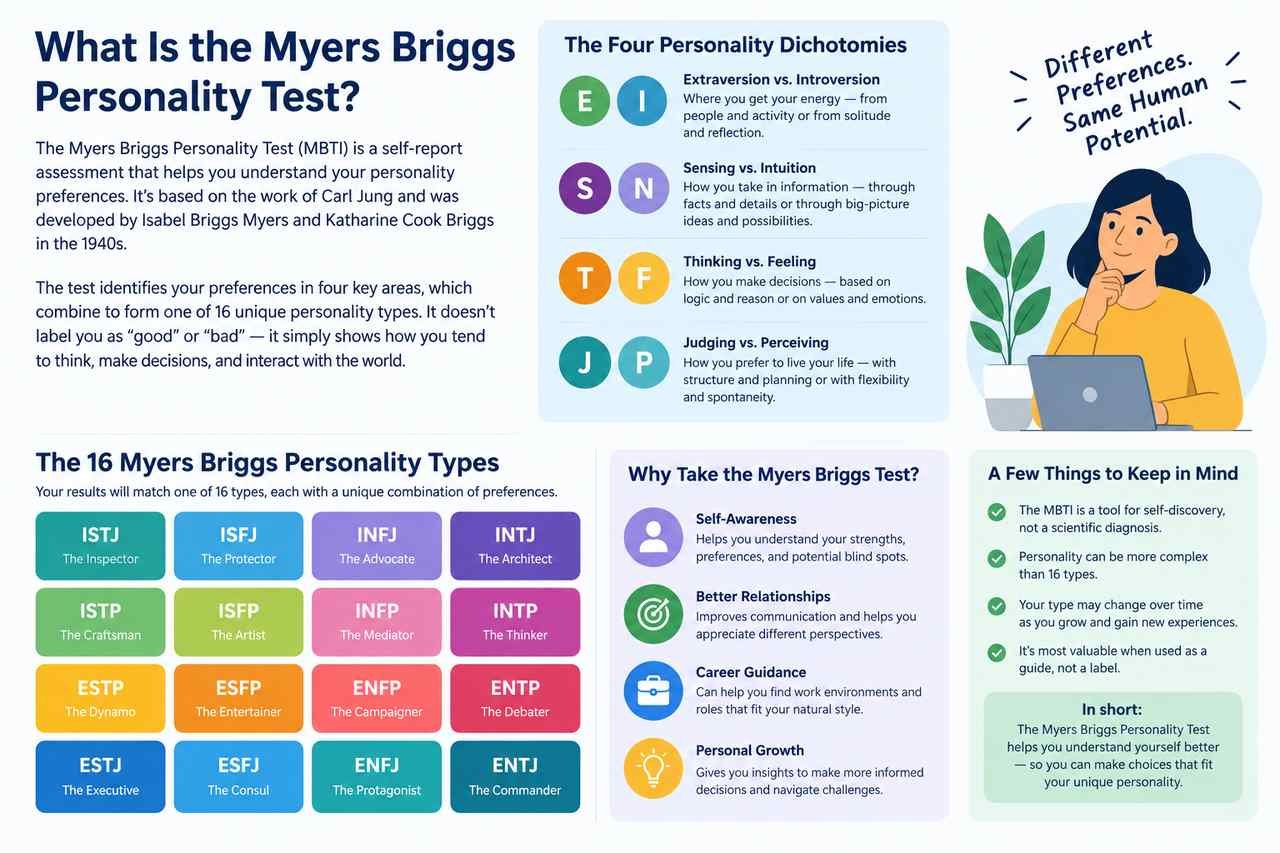
Understanding your Myers-Briggs Personality type can help you and those around you improve your communication and enjoy deeper, more fulfilling interpersonal relationships. It offers insights into your value system, your behavioral patterns and your preferred modes of activiity.
There are eight psychological functions, including extraversion and introversion. The Myers-Briggs Test describes personality type by the identity of the preferences of the individual. Within each of the eight functions, there are degrees, and combinations of the functions create the 16 personality types.
Your personality has a bearing on the nature of your interpersonal relationships and understanding your personality helps you understand yourself better. It is recommended that you take the Myers-Briggs Type Indicator online. It is best to take a series of the inventory because there are variations with the testing services. Each person is unique. The more you understand yourself, the easier it is for you to engage and build lasting relationships with others.
According to your responses, we are able to make an informed guess about your personality type. Continue to read to better understand yourself.
The Myers-Briggs Type Indicator (MBTI) is the result of the efforts of many people, but was developed primarily by Katherine Cook Briggs and Isabel Briggs Myers. It was created using the ideas of Carl Jung.
The Four Areas of Myers-Briggs
Four areas of measurement have been defined by Myers-Briggs.
- Extraversion/Introversion
- Sensing/Intuition
- Thinking/Feeling
- Judging/Perceiving
Each of the eight elements within the four areas are measured and preferences determined.
Preference levels are combined to define a type.
Types may include:
- INTJ
- ESFP
Individuals may not always act consistent with their preferences. For instance, an individual with an I preference may seek out group activities. Another individual with an E preference may prefer to participate in activities alone.
Using preferences people may define their personality within the framework of 16 different types.
Using the theory, the total number of combinations is 2 raised to the fourth power (16) and therefore each type may define a personality.
Types According to the Myers-Briggs Personality Test
There are 16 Types in total.
Type Group
MBTI Type
- Sensing
- Judging
- Preference
- ISTJ
- ISFJ
- INFJ
- INTJ
Sensing
- Judging
- Preference
- ISTP
- ISFP
- INFP
- INTP
Flexible Types
Type Group
MBTI Type
- Sensing
- Judging
- Preference
- ESTJ
- ESFJ
- ENFJ
- ENTJ
Flexible Types
As you can see, the naming conventions are fairly free form. As such, when seeking a description of your personality type, it is most prudent to rely on your 4-letter code.
Each of the dimensions are equally important to the framework of the Myers-Briggs personality type model. We will examine the other 3 below.
Extraversion vs. Introversion
The second dimension examines whether a person prefers Extraversion or Introversion.
Extraversion (E)
A person with Extraverted preference is one in which their natural energy is directed outward. As such, they focus on people and activities outside themselves.
Introversion (I)
Someone with an Introverted preference is naturally directed inward. Consequently, they focus on people and activities within themselves.
It should be noted that people can have:
- A strong preference for being alone
- A preference for group work
- A preference for talking over writing
- A preference for creating a work environment that reduces interruptions and distractions
- A preference for quiet work
- Comfort in socially isolating situations as long as they are not required to communicate often or in great detail.
Myers-Briggs Personality Type Indicator (MBTI)
Individuals who prefer Intuition (N) pay more attention to subjective elements of an experience and people who prefer Sensing (S) pay more attention to objective elements of an experience.
Sensing
People who prefer Sensing focus more on the objective elements of an experience. For example, they may attend to the details and the concreteness of an experience. People who prefer Sensing may learn and work best when provided with literal examples and evidence and when they are given the opportunity to learn and work in a direct, Concrete manner. Sensing people may also want to understand the internal details of a mechanism in order to learn how it works.
Intuition
People may prefer Intuition if they focus on the more subjective elements of an experience. Human who prefer Intuition may pay more attention to the relationship of various elements. People may prefer to learn and work best when provided with more abstract elements. People who prefer Intuition may be uninterested with the current state of things.
Thinking and Feeling
People may prefer Thinking to resolve their internal conflicts and may act based on more logical elements of an experience. People who prefer Feeling may act based on more subjective and emotional elements.
Feeling
People with this preference base their decisions on relationships and their understanding of others’ feelings. People with Feeling preference strive for choices that permit them to honor and support the people affected. When making choices, they take into account probable effects on others. They attempt to make decisions in a way that provides avoidance and consideration for the feelings of the people concerned. Sometimes, a person with Feeling preference, in making a decision, needs to analyze the given situation. This person may reach conclusions based on the analysis of relationships and values.
Judging and Perceiving
Differences among individuals due to Judging and Perceiving preferences are similar to Thinking and Feeling preferences. For example, some individuals may prefer coming to end of a process and closing a chapter, while others may prefer to keep the process open and leave options for the future.
Judging preference is the last of the eight preferences.
Judging does not mean being critical of others, and Perceiving preference does not mean being lackadaisical.
Understanding Your Myers-Briggs Results
When you take the Myers-Briggs Type Indicator™ (MBTI®) Step I or Step II personality inventory, you may identify with Integrated Thinking (I), Sensing (S), Feeling (F) and Intuitive (N) or Extraversion (E) and Introversion (I). Based on your results, you may likely identify with Integrated Thinking, Sensing, Intuitive, Feeling, Judging and/or Perceiving. When interpreting your results, you should consider your preferences as a holistic unit rather than individually.
You should express your preferences in your own words rather than stating definitions.
The 16 Myers-Briggs Personalities
Understanding the individual components of each of the 16 Myers-Briggs personality types will help you understand the Myers-Briggs framework.
Focused on Judging (J)
There are several characteristics that are attributed to an ISTJ personality type. They are practical, detail-oriented, organized, and responsible.
ISTJs like structured environment and prefer working with real, concrete, and definitive information. They also need to be given means and ways to attain their end. They are good at analyzing and understanding the steps needed to complete a task. In the process, they may need and appreciate set of rules. While an ISTJ may not be flexible and creative, they can be and will be good at task-oriented activities.
A person’s Myers-Briggs personality type is not a complete definition of a person.
Focused on Feeling (F)
ISFJs are described as caring and loving. They consider other person’s feelings. Like organized, clean, and simple environments. They enjoy helping people and also like working with definitive information. Feel responsible when people depend on them for assistance. They enjoy performing valuable services to people.
One value of an INFJ person is helping to transform people’s lives and bringing positive change. They enjoy creative activities and also enjoy planning and working to achieve change. They appreciate services activities that allow them to come in contact with large number of diverse people.
INTJs enjoy activities that help them understand how and what systems are integrated and work. They appreciate and enjoy working to change and improve systems and processes in a organization.
Personalities are generalizations. Therefore, an individual may not completely represent their type.
ISTP – Introverted – Sensing – Thinking – Perceiving
Individuals of this type enjoy and excel in solving problems, especially in an justifiable manner. They enjoy and thrive in an environment that involves some sort of mechanics or other moving parts that require manipluation.
Things that interest a person of this type are:
- Working with and using tools
- Solving problems involving mechanics
- Acting out and interacting within a system
- Competing
ISFP – Introverted – Sensing – Feeling – Perceiving
ISFPs are creative types who thrive in expressing and experiencing the more emotional side of life and in turn represent it in a beautiful manner.
A few things that may interest this type are:
- Activities that are practical and of the concrete nature
- Experiences
- Existing in and representing reality
- Those that are true and real in their dealings with ISFPs
- IntFPS are quick to take offense in those that are self-centered and fake
INFP – Introverted – Intuitive – Feeling – Perceiving
Creativity is the hallmark of this type, and they express this creativity in various forms and manifestations. They are deep and ponder the deeper meanings in life. They are comfortable with and prefer ambiguity.
Things that may be of interest to INFPs are:
- Art
- Creative Writing
- Day dreaming
- Reflecting
- Relationships that are meaningful and fulfilling
- Acting in a manner that is congruent to their beliefs
INTP – Introverted – Intuitive – Thinking – Perceiving
In abstract thoughts, INTJs are able to figure out and deduce the inner workings of mechanics and other logical and reasoning systems. They are at ease with and prefer the world of the abstract, the unknown and the future.
INTPs:
Are attracted to
- Intellectually stimulating conversation
- Scholarship
- Organization of data and reasoning
- Sysmmetrical and logical thought
Inquisitive, particularly regarding
- The inner workings of mechanisms, systems and devises
Are drawn to
- The speculative nature of abstract concepts and thoughts
May be able to
- Visualize multiple points of view concerning a given situation
ESTP
ESTP:
- Are practical and directly action-oriented
- Prefer situations and environments which provide stimulus for immediate response
- Are good at identifying and understanding interpersonal situations and issues
- Are playful, energetic and active
- Learning occurs primarily through direct experience
- Prefer flexible and open ended environments
ENFP
ENFP:
- Prefer flexible, interpersonal, and open ended environments
- Are creative and playful
- Are speculative, imaginative, and emotionally sympathetic
- Have a strong interest in social and interpersonal situations
- Prefer to collect and explore new and varied experiences
- Are drawn to alternative possibilities, concepts, and speculation
- May become restless if constrained to a rigid schedule and/or controlled by overly defined limits
ENTP
ENTP:
- Have a strong interest in speculation, alternative and abstract concepts and possibilities
- Are energetic, active and enjoy a variety of activities and situations
- Thrive on and enjoy the process of constructing new ideas
- Are playful and enjoy theorizing and formulating ideas
- May become restless if situations become overly controlled and rigid
They are open to suggesting and offering up theories. They are enthused by the opportunity to interrogate concepts and often relish the opportunity to dispute ideas. Individuals of this type tend to be comfortable living and working with a degree of ambiguity. Generally speaking, they are more comfortable reviewing a variety of possible options, than considering and focusing on a single solution to a problem.
Extraverted (E) Sensing (S) Thinking (T) Judging (J)
If they are typically order loving and thrive in structured and organised environments.
They tend to be goal directed and involved in the practical aspects of work.
Why they tend to prefer and enjoy a structured and organized workplace. They are ready to take charge and are relatively comfortable assuming a leadership role.
Among others, they find enjoyable:
- Working with and interacting with people
- Planning
- Organizing
They typically express their values and interests in the nature and quality of their interpersonal relationships.
ENFJ
With extraverted (E) intuitive (N) feeling (F) and judgment (J), they are interested in and enjoy communicating and organizing people.
They enjoy planning and setting goals, and determining and evaluating the strategies and means to be employed to achieve goals.
Analyzing components of the different types provides insights into the processes by which people come to behaviors and choices.
This may enhance the resolution of interpersonal workplace conflicts.
Myers Briggs Personality Tests
Mysers Briggs Personality Tests are widely available on the internet and most charge a fee.
If you are considering taking one of these tests, you should look at the following.
The name of the test may indicate that it is a personality type test based on Myers Briggs. Other tests may be based on other 16 type frameworks. Still other tests may have nothing to do with Myers Briggs type classification.
The official Myers Briggs Type Indicator is not free and the free tests available on the internet are not the same as the official test.
When taking a free test, you should look to see if the test is legitimate.
A good website will give you an overview of the test and help you understand your results.
Check to see if the website has a privacy policy. The policy should indicate that your personal information will not be shared with other organizations.
The statements on the website should be evaluated to determine if they are legitimate.
A good test will not make statements such as, “This test will tell you your true relationships”, or “This test will help you determine your best career choice.”
The statements in the test should be evaluated for face validity.
Expect the following in the assessment:
- Grammar and spelling
- Question order
- Your personal information
- How you physically or mentally take action
- etc.
The assessment may be multiple choice, true or false, or sentence completion.
To enhance reliability, respond to your actual preferences as opposed to your perceived preferences.
Focusing on your preferences as a whole will likely yield more meaningful insight as opposed to focusing on a singular preference. Let’s say you identified as an INFJ; don’t lose yourself in analysis paralysis for why you went to a concert as opposed to staying home.
The Myers-Briggs Type Indicator
The Myers-Briggs Type Indicator is made up of the following dichotomies:
- E (Extroversion) or I (Introversion)
- S (Sensing) or N (Intuition)
- T (Thinking) or F (Feeling)
- J (Judging) or P (Perceiving)
Combining the above pairs yields 16 personality types. For instance, an ENFP or an ISTJ.
Myers Briggs Personality Test and Self Awareness
Questions for the individual taking the test:
- What is your general opinion on the description?
- What aspects of the description do you agree with?
- In what other ways are you similar to the description?
- Are there aspects of the description you do not agree with?
- What are your interests?
- What things make you angry?
- What helps you relax?
- What things create a state of anxiety for you?
Of the four questions above, what is most important is your understanding of yourself, not your knowledge of your Myers Briggs personality type.
Myers Briggs Types and Communication
There are differences in the ways in which people prefer to communicate. Some prefer to communicate in a concise manner. Others prefer to communicate in a manner that includes more details.
This is something that merits more discussion.
There are numerous ways of communicating and understanding differences in people that may be helpful in this case.
For instance,
- Some people prefer to communicate by means of a letter.
- Some prefer to communicate by means of illustrations.
- For some people, rules are more important than relationships.
- In the case of other people, relationships are more important than rules.
Understanding these differences may allow a person to identify the ways of communicating preferred by others.
Understanding MBTI at Work
Workplace decisions hinge on understanding your colleagues’ preferences.
- Some people are inclined toward planning, while others are more inclined toward improvising.
- Some people enjoy or are comfortable with working independently, while others enjoy or are comfortable with working with or alone.
The same is true when considering approach to work. Some people thrive in structured work environments, while others prefer unstructured or unrestrained work environments.
Personality is just one dimension when considering work and career choices.
Personality may be helpful when considering work and career choices.
When thinking about your professional future, you must take into consideration:
- Your Training and Education
- Your Passions
- Your Talents
- Your Prior Employment
- Your Financial Condition and Concerns
- Your Level of Job Contentment
- Your Long-Term Career Goals
- Your Personal Values
- The Geography of the World
- The Quality of Life You Desire to Lead
The types of careers that are good choices for Extroverts and Introverts are plentiful. Sometimes your personality determines the careers that are good choices for you. People with interst in finance may thrive in a career in accounting. Accounting is a good career choice because many accountants are self employed and work independently.
Myers-Briggs and More
Personality dynamics are very useful when developing interpersonal relationships.
The foundation of most relationships is communication. Personality frameworks and typologies may help identify the type of communication your partner needs in order to feel secure and comfortable.
Take caution when taking online tests that purport to be like Myers-Briggs. It is illegal to reproduce Myers-Briggs, and other proprietary tests, and the creators of the tests may not educate the public adequately on the theory and frameworks. Hence, there are numerous tests called the ‘16 Personality Test’ and the like that purport to be like Myers-Briggs.
Is Myers-Briggs Valid?
Myers-Briggs is a topic of discussion in the field of psychology.
Adequate research has led the general population to describe themselves and others using Myers-Briggs with a reasonable level of accuracy.
Nevertheless, critics of Myers-Briggs state that the framework lacks adequate research to substantiate the categorical nature of personality.
For instance, a person may exhibit tendencies of both introversion and extroversion in varying situations and to varying degrees.
Although the MBTI has gained popularity in the field of personality research, a scientifically valid way of measuring a person’s true nature may not be adequately represented using the framework.
The Big Five framework of personality research states that personality is composed of neuroticism, extroversion, openness, conscientiousness, and agreeableness.
These facets of personality may be of interest to research the general population to a greater extent.
The Big Five model of personality focuses on the dimensions of personality.
The Myers-Briggs Type Indicator (MBTI) classifies individuals into 16 personality types based on preferences.
Regarding preferences, such as extroversion and introversion, individuals may not be at the extremes but rather more centered.
Other models of personality may contain similar kinds of preferences.
Is it possible to change your MBTI?
With the MBTI, the goal is to assess your true self and, therefore, capture your real personality. Thus, individuals may feel their true self was not fully expressed.
As an individual changes and evolves throughout his/her life, results from the Myers-Briggs Personalty Inventory and other assessments based on type may also reflect this change.
In addition, the environment in which the individual lives and works influences the individual’s personality.
Many factors may result in an individual personally constructing different meanings to a personality assessment instrument and, therefore, yielding different results.
Those results may also vary because of differences in the complexity of the instruments and the kind of statements and/or questions asked.
Individuals may also express different aspects of their personality at different times. Thus, it may be constructive to analyze the results to ascertain why and in what way preferences have changed.
Common Misconceptions About The Myers-Briggs Type Indicator
Myth 1: People with Extraverted (E) Preference are Always Outspoken and Enjoy the Presence of Many People.
It is true that many people with an Extraverted preference enjoy the company of others and may even seem outspoken, but this doesn’t mean that they won’t eventually become tired by and need alone time to re-energize.
Myth 2: People with Introverted (I) Preference are Anti-social and Don’t Like Being with People.
People who prefer Introversion may enjoy the company of others and be social, but may become tired and need alone time.
Myth 3: People with a Thinking (T) Preference are Calm and Collected but Don’t have Feelings.
Being focused and making decisions based on thoughts and logic does not mean that there isn’t passion and feelings involved.
Myth 4: People with Feeling (F) Preference are Irrational.
People with feeling preference may seem irresponsible or arbitrary, but may be rational and logical when making decisions.
Myth 5: Judging (J) Means a Person is Critical and Judgmental.
In reality, preference for Judging means that a person likes closure and enjoys being organized and structured.
Myth 6: People with Perceiving (P) Preference are Disorganized.
People with a preference for Perceiving may actually be organized.
Myth 7: A Person’s Relationships and Careers are Restricted to their Myers Briggs Type.
Ultimately, one’s preferences and interests determine their relationships and careers.
Knowing Your Myers Briggs Personality Type
Awareness of one’s Myers Briggs personality type can help in many day to day situations.
Awareness of Self
This helps you understand your choices, limitations, and behaviors.
Awareness of Others
This helps you understand how people communicate, especially in unfamiliar situations.
Discussing Work
You can use your Myers Briggs type to illustrate your preferences regarding work-related issues.
Recognizing Your Potential
You can develop areas you consider weak based on your type.
Type in General
There are several situations where an understanding of an individual’s personality type can provide an insight on the choices he/she made in a given scenario.
The Myers Briggs Test
There are many limitations to the Myers Briggs type test, despite its widespread use and fame.
Myers Briggs and Reality
There are so many factors that influence an individual’s choices, including their personality.
Myers Briggs and the Real World
An individual cannot be fully expressed by the myers briggs type.
The Myers Briggs Test
The same individual can be given a completely different type by the test, based on the examiner’s interpretation.
Myers Briggs and Intelligence
An individual’s myers briggs type says nothing about how intelligent or unintelligent he/she is.
The Myers Briggs and the Workplace
Myers Briggs type should not be the determinant factor when hiring or firing.
Myers Briggs and Personality Change
People can change their personalities.
The Myers Briggs Test
It can be useful to enhance your self-awareness, as long as you don’t take the results too seriously.
Suggested Response
“This indicates I might like to do X using Y.”
This approach gives a user liberty to invent amusing example statements to fill preferences and work on their blind spots.
All Preferences Can Be Trammeled
Someone with a preference for Introversion can work on their public speaking skills.
Someone with a preference for Judging can work on their flexibility and willingness to deal with the unexpected.
All preferences can be trammeled.
Some one with a preference for Thinking can work on being more emotional and dealing with interpersonal relationships.
Someone can learn to be a Perceiver instead of a Judger.
The focus of Myers-Briggs Type Indicator (MBTI) is to describe a person and provide hints on how a person can improve.
Once you complete the MBTI assessment, consider the suggestions and feedback in the various ways described.
- Consider your preferences.
- Think about the behaviors that help you accomplish your goals.
- Consider your Tendencies.
- Think about the preferences that help you in various situations.
- Consider your Interpersonal communication Preferences.
- Think about the preferences that help you in social communication.
- Consider your Working preferences.
- Think about the levels of Independence you want and need.
- Consider descriptions in abstract to reflect your true self.
Users are searching for information on:
- career development
- relationship development
- ways to improve communication
- workplace Amity
- workplace performance
- learning styles
- work/preferences
- interpersonal behavior
- Introspection and predilection for interpersonal circumspectiveness
Interest for Myers Briggs and related free personality evaluations is high.
Results of the online evaluations are typically circular and justify little about the principles or the psychology on which they are founded.
Myers Briggs is beneficial for Individuals at all three levels.
Knowledge of Myers-Briggs Type Personality assists the Individual in identifying his/her/their persona preferences and strengths.
It is not uncommon for individuals to develop a predilection for a particular style of behaving and functioning to enhance their well-being.
However, behavioral plasticity and versatility is desired to modify one’s behavior to instill positivity in interpersonal dealings.
Being true to one’s self encompasses all the above.
Myers Briggs Type Indicator (MBTI)
The MBTI instrument is based on the Myers Briggs Type Indicator and assists in identifying preferences in the same area.
There are 16 personalities in Myers Briggs.
These are determined by the combination of preferences of the four pairs of opposition.
What are the four dimensions of Myers Briggs?
The four dimensions are:
- Extraversion/Introversion
- Sensing/Intuition
- Thinking/Feeling
- Judging/Perceiving
Is there a free Myers Briggs personality test?
The official Myers-Briggs Type Indicator® (MBTI®) personality test is not free. However, there are many similar tests that are free to take online.
What do Myers Briggs personality results mean?
By taking the personality test, you will determine your preferences and be given a four letter code. Each code corresponds to a personality type. For example, a personality type of INFP means that person is predisposed to Introversion, Intuition, Feeling, and Perceiving.
What is the Myers Briggs personality test format?
The format of the Myers Briggs personality test is to determine your preferences in 16 different aspects and then be evaluated in 16 different personalities.
Is Myers Briggs a test of intelligence?
No. The Myers Briggs personality test assesses preferences, and is not a test of intelligence.
Can this test help me decide what career to pursue?
The Myers Briggs personality test assesses your personality, and is not designed to assess your interests or skills.
Will my Myers Briggs personality type change?
It is possible that your Myers Briggs personality type will change given the influences of the environment and self-awareness.
How are the 16 Personality Tests and the MBTI different?
MBTI is a framework to analyze 16 personality types. Other tests based on the framework might vary and therefore can not be substituted.
Is the MBTI a Psychological Test?
MBTI is not a psychological test.
What does J mean in the MBTI?
This refers to a preference for judging (J) or perceiving (P). Judging means a preference for a structured and organized way of interacting with the world.
What does the mean P in the MBTI?
If the preference is perceiving, it means an individual prefers flexibility and variety in interactions with the world.
What is the most common personality type?
It is difficult to determine the most predominant personality type. Therefore, conclusions on the predominant type should be re-evaluated.
Do personalities to change?
Yes, most likely a person changes his/her personality type through the course of his/her life.
Can the MBTI describe personalities accurately?
Yes. It describes types based on preferences in various situations (socially, at work, while relaxing, etc.).
What are your views on the MBTI?
MBTI describes preferences based on differences and varies in accuracy. Overall, it is a good tool for description.
The framework describes eight pairs of functions that people can prefer. These are the basis of the MBTI instrument.
- People can prefer extraversion or introversion.
- People can prefer sensing or intuition.
- People can prefer thinking or feeling.
- People can prefer judging or perceiving.
The MBTI instrument identifies 16 different personality types based on the eight functions described above.
A number of “free” versions of the MBTI assessment are available. It is important to be mindful of the research behind each assessment and the rationale for the assessment before drawing any conclusions. The term “research” and “assessment” are often used interchangeably.
Knowing your MBTI type helps with the following:
- Working through decisions, particularly in a group setting.
- Understanding your choice of occupation and career satisfaction.
- Understanding your level of structure and organization in your day to day activities.
- Recognizing communication styles and differences.
A more appropriate question to ask is “how do my preferences impact my communication and my work?”
Reflecting on your preferences helps understand yourself at a deeper level and gives insight into how you can be more effective.